
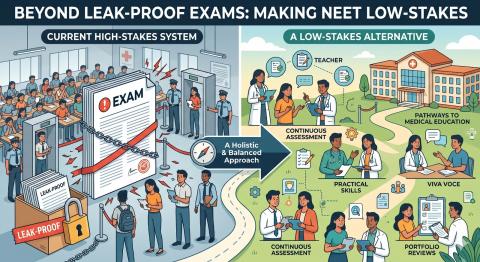
Beyond Leak-Proof Exams: Making NEET Low-Stakes
The recent controversy around NEET has once again pushed the conversation toward making the examination “leak proof.” This demand is absolutely valid. Any examination system must protect fairness and public trust. But I often feel that our response remains limited to last-minute arrangements. It is somewhat like increasing the height of a dam every monsoon to stop flood water from entering villages and cities. It may work temporarily, but the long-term solution lies elsewhere — in creating multiple channels through which the excess water can flow.
Similarly, the real reform in education is not merely computerising answer sheets or shifting toward computer-based assessments. Technology is only a medium. The deeper question is: what are we assessing, and how are we assessing it? Unfortunately, there is still very little serious public conversation around this.
NEET has become a high-stakes examination because too much depends on a single test. Every year, millions compete for roughly 1.26 to 1.29 lakh MBBS seats across government and private institutions. Out of these, only around 56,000–60,000 seats are in government medical colleges, where the fees remain affordable for ordinary families. Scarcity naturally creates extreme pressure, anxiety, coaching dependency, and vulnerability to malpractice.
The major demand, therefore, should not only be stricter surveillance or stronger policing of exams, but a massive expansion in capacity. If India doubles or triples its medical intake, NEET would automatically become a lower-stakes examination. And the important question is: who stops us from doing this?
The estimated cost of adding nearly 1.2 lakh additional MBBS seats is around ₹1.8–2.5 lakh crore. At first glance this appears enormous, but spread over five years, it amounts to only a tiny fraction of the combined expenditure capacity of the Union government, state governments, and the CSR ecosystem. India already spends around ₹35,000 crore annually through CSR initiatives. Institutions like the BCCI generate more than ₹10,000 crore every year. A coordinated national mission involving governments, philanthropy, CSR, and public-private partnerships can realistically build this infrastructure without imposing an unbearable burden on the economy.
But expansion alone is not enough. We also need multiple pathways into the profession of medicine. Engineering already offers such flexibility. People enter the field through B.Tech, BCA, B.Sc., M.Sc., and several interdisciplinary routes. Medicine, too, can evolve in this direction. Schools, for instance, could recommend a small percentage of students based on long-term observation of aptitude, discipline, empathy, and sustained interest over several years rather than a single afternoon examination. Graduates from biology, chemistry, and allied disciplines could enter shorter bridge programs where AI-supported learning may help address knowledge gaps efficiently.
The point is not to eliminate NEET, but to reduce the disproportionate weight placed upon it. Once multiple entry points and larger capacities emerge, the exam will naturally become less stressful, less vulnerable, and perhaps even more meaningful.
Of course, making the current examination system secure and transparent must remain the immediate priority. But genuine reform requires long-term strategic thinking. Otherwise, every year we will continue repairing the dam, while refusing to rethink the river itself.
- Log in to post comments