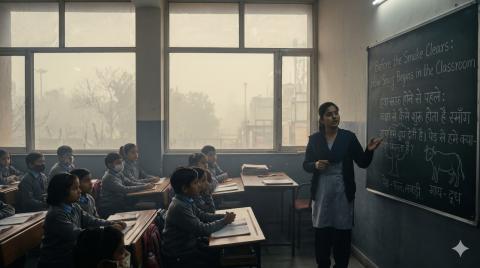
Pollution and Pedagogy
Pollution has crossed all limits, surpassing all possible measures, and it is suffocating people's lives. Elderly people and children are already suffering. The rest of the population is suffering as well, but the impact will become fully visible perhaps after a couple of years, when their immune systems become weaker. Almost all research proves that breathing such air is actively shortening people's lifespans. Of course, people look at some of the immediate reasons that are quite prominent—this could be firecrackers, vehicular emissions, emissions from industries, the burning of agricultural waste, and so on.
But I think if we look deeper, the real reason lies in our fundamental understanding and our relationship with the ecosystem we live in. I was recently observing one of my student teachers taking her class, and she was teaching a very interesting thing: "Gaay hamein doodh deti hai. Ped se hamein kya kya milta hai? Ped se hamein phal milte hain, lakdiyaan milti hain..." (A cow gives us milk. What all do we get from trees? From trees, we get fruits, we get wood...), and so forth. The reference to every single thing that is non-human was framed entirely in terms of its utilitarian value. It implied that everything existing other than human beings exists solely to serve humans. It conveys that the existence of trees, cows, other animals, or other species has no intrinsic worth of its own; they exist merely because humans need them.
This mindset has become an ingrained part of our day-to-day language and our vocabulary. Consequently, a child who grows up listening to this right from the very beginning will never hesitate to cut down a tree to expand their house or build a road, because that is repeatedly what they heard and what they read in their textbooks.
If we closely examine the root causes of pollution, it cannot be separated from this collective consciousness of human beings on this planet, through which we are all together destroying it. There are immediate measures and long-term measures to be taken, but how we conceptualize nature through language must be addressed, and that demands special attention. Unless we re-establish our worldview and start valuing existence as an end in itself—rather than attaching value to animals, trees, and other species based strictly on their utility to humans—no matter what else we do, we will always find one way or another to destroy them.
This is where the true long-term solution lies: in identifying, confronting, and altering this language of violence—for I will call it a language of violence—and rectifying it. We must embrace a new understanding: a tree does not exist because it serves us; a tree exists because it is an integral part of this planet, and it has every right to exist whether it holds any utilitarian value for me or not. A cow does not exist merely because it gives us milk; it is a part of this planet and has every right to exist.
Researchers have already defined this current epoch as the Anthropocene, highlighting how human-centric dominance defines our era. That very anthropocentric approach is perhaps the most damaging factor to our environment. We have already started witnessing its catastrophic impacts in the severe pollution in Delhi and across the globe, with people facing diverse forms of climate crisis. If the planet is to survive, we will have to deconstruct this anthropocentric mindset. We must re-establish the idea of the planet as a shared home for all, where every entity holds its own intrinsic value—a value that does not depend on whether a human needs it.
