
The Inevitable Nature of Workplace Politics
Every workplace eventually develops its own politics. Different institutions, different people, different rules—but remarkably some similar patterns. I have increasingly come to believe that workplace politics is not merely a consequence of flawed individuals; it is often a natural outcome of how organizations function. Politics emerges wherever resources are limited. These resources may be tangible, such as promotions, budgets, or desirable assignments, or intangible, such as recognition, influence, autonomy, or proximity to decision-makers. Formal rules determine part of their allocation, but the discretionary opportunities are often shaped by relationships, trust, and informal influence. This is where workplace politics begins. No matter how objective or scientifically designed an organization claims to be, resource allocation remains deeply embedded in what philosophers call an intersubjective reality—a reality constructed through shared perceptions, relationships, and human judgment rather than objective rules alone.
Positions of power make objectivity much harder to sustain. Even well-intentioned leaders are influenced, often unconsciously, by repeated interactions, loyalties, familiarity, and interpersonal relationships. This is not necessarily a failure of character; it is part of being human. There is a well-known principle in the judiciary: Justice must not only be done, but must also be seen to be done. I believe the same principle applies to leadership. Employees judge not only whether decisions are fair but also whether they appear fair. Research consistently shows that leaders play a significant role in shaping organizational culture. Yet this expectation can also become a burden. In an institution of a hundred people, expecting one individual alone to embody fairness, resolve every conflict, and create a healthy culture is an enormous responsibility. I have seen many capable leaders struggle under the weight of these expectations. One obvious response is to distribute leadership. Shared leadership can reduce bias, diversify perspectives, and create greater accountability. However, it also requires distributing authority and influence—something that organizations and leaders are often reluctant to do. Perhaps that is the paradox of leadership: The greater the power, the greater the responsibility—and the greater the expectation to rise above one's own subjectivity.
The nature of workplace politics changes from one institution to another because the "prizes" are different. In a marketing company, competition may revolve around prestigious clients, larger territories, international travel, or strategic projects. In government offices or educational institutions, where salaries and many formal benefits are standardized, politics often shifts toward subtler forms of privilege: a preferred workspace, flexibility in schedules, participation in prestigious committees, opportunities for visibility, or simply greater access to those who make decisions. The contest remains the same; only the currency changes. I find a similarity with the Concentric Zone Theory developed by the Chicago School of urban sociology. Cities were understood as being organized around a centre of economic activity, with different social groups occupying successive rings around that centre.
A similar pattern often appears inside organizations—not in terms of physical distance, but relational distance.
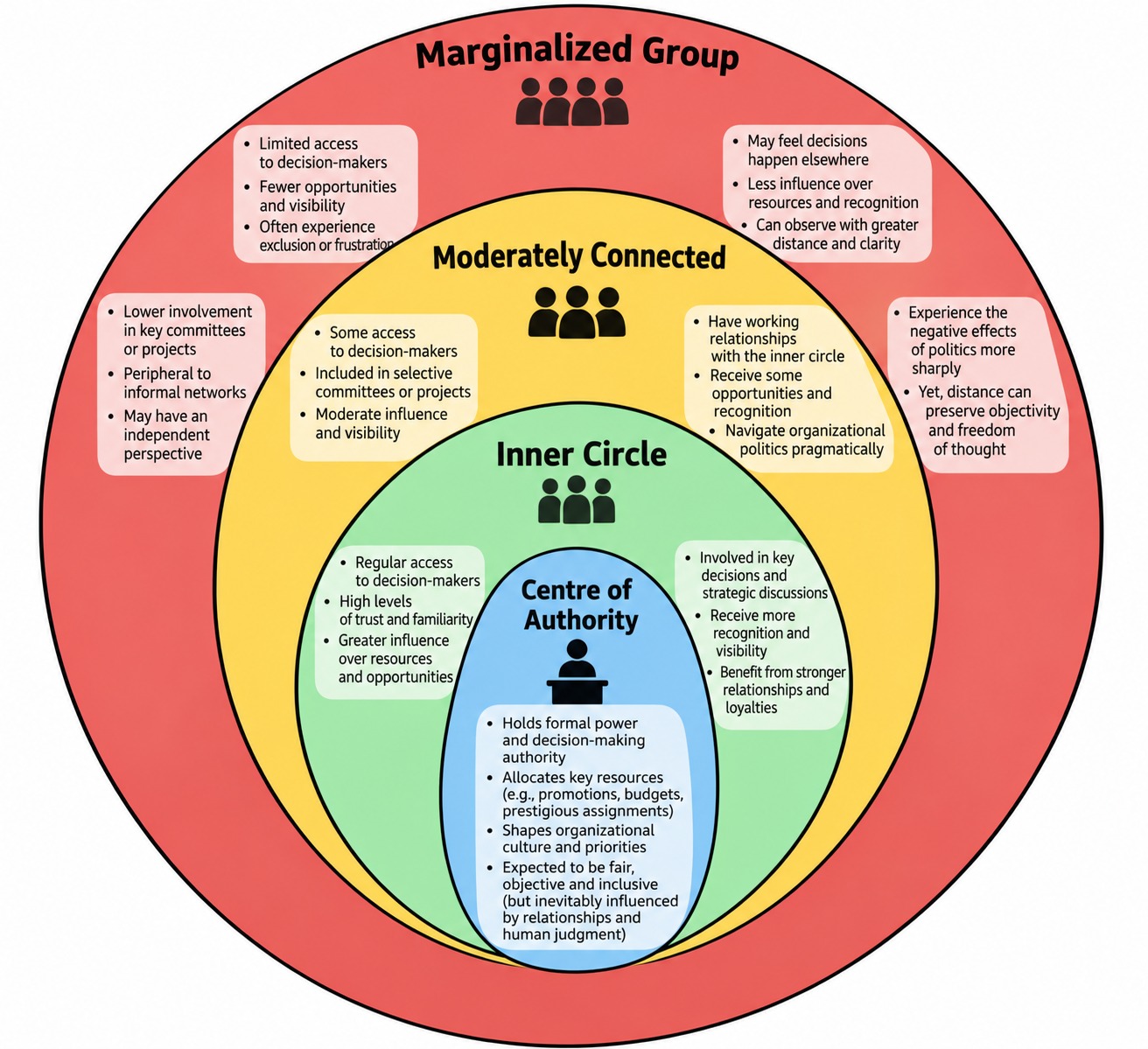
At the centre lies authority. Around it are successive circles of people with varying degrees of access, trust, and influence. Those on the outer circles frequently experience exclusion, frustration, or the feeling that important decisions happen elsewhere. Like every analogy, this one has its limits. Yet it helps explain why individuals occupying different positions within the same organization often experience completely different realities. The Vantage Point of the Margins Ironically, those on the margins may possess something invaluable: distance. Distance often allows greater clarity. Those removed from the centre of power are sometimes better positioned to observe organizational dynamics without being deeply invested in them. The closer one moves to power, the more difficult it becomes to remain completely objective. Influence, recognition, and belonging can subtly shape one's judgment. Power is not only institutional; it is also psychological. Of course, remaining on the margins comes at a cost. It may involve fewer opportunities, reduced influence, and a persistent sense of exclusion. Yet it can also preserve an independence of thought that is difficult to maintain closer to the centre.
Research has repeatedly shown that workplace politics can either create environments where people flourish or conditions that gradually push them toward disengagement and withdrawal. A healthy organizational culture therefore cannot be treated as a luxury; it is fundamental to institutional effectiveness. Technology, including AI, may improve transparency, strengthen accountability, and reduce certain procedural biases. But politics itself cannot be eliminated through technology because it arises from human relationships rather than algorithms. Ultimately, healthier workplaces are built not only through better systems but through better judgment. Fairness, trust, and integrity remain profoundly human achievements. The most meaningful changes in organizational culture begin not with surveillance or regulation, but with the everyday choices people make in exercising power with humility and receiving it with responsibility.
- Log in to post comments