
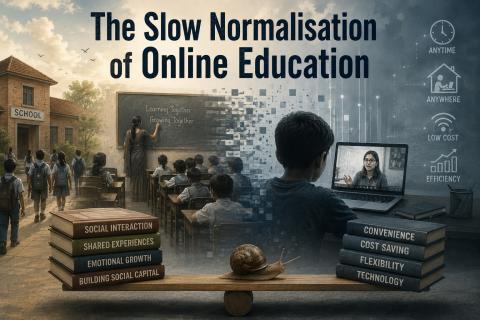
The Slow Normalisation of Online Education
The country is getting ready to embrace an economic slowdown. Several austerity measures have been suggested, and one of them implies the promotion of online education. And it is perhaps from this broader concern about how economic decisions gradually reshape everyday life that my deeper worry about online education emerges. The objective of this piece is to communicate that the current situation may demand austerity measures, but we need to remain vigilant that certain practices do not slip into normal routine, as there is such a possibility with online education. One of the reasons is that the state, as a provider, finds it far more convenient to deliver educational services in the online mode than in the offline mode. I am also not arguing against the merits of online education. It is a great tool for self-paced learning and for giving access to quality educational materials in geographically difficult areas. I simply argue that it should serve where it fits best; it should not enter the domain of formal education as a normal practice. Because once emergency measures begin to alter the structure of work, mobility, and public life, they also begin to influence how we imagine education itself. However, my deeper concern is with the push for online classes that this whole initiative justifies.
Within a few years, online classes have returned, and my concern is that these emergency measures do not become the new norm. Because online education is not education, at least during the schooling years. There are reports that many colleges have continued the practice of online classes even in the post-Covid period. The return of this practice will further give sanctity to online classes as a new normal. And as I think, we may enter an era where the poor will have online classes while schooling remains reserved for the privileged. Both educators and learners know that online classes are not a great way to engage in learning, particularly in the formative years.
Among college-going students, this may still be useful, but the university serves altogether a different purpose. The primary purpose of the university remains learning, but what follows is often far more crucial. That is the bond students develop during their college years. This network of friends, in most cases, shapes how they will thrive in life. In this context, in Bourdieu’s terms, the university is a great place to build social capital. An online mode of university education deprives students of the opportunity to build this social capital. And sociologists believe it takes decades to convert economic capital into social capital. In this context, even the gain of economic capital is not guaranteed.
Perhaps this is the larger question before us: whether convenience should become the guiding principle of public life. Because every society, at some point, must decide what it values enough to protect, even when it becomes expensive, difficult, or inconvenient. Schools and universities are not merely spaces where information is delivered; they are living social spaces where children and young people learn how to exist with others. And once such spaces are gradually replaced by screens in the name of efficiency, it may take decades to recover what is lost. Economic slowdowns may pass, but certain shifts in society, once normalised, remain with us for generations.
- Log in to post comments