
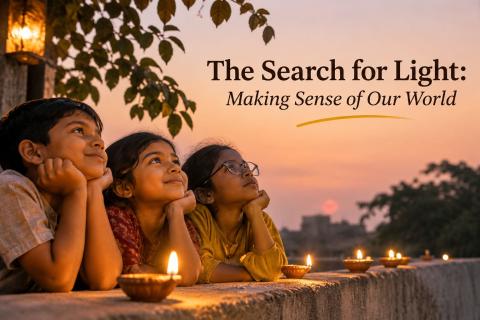
The Search for Light: Making Sense of Our World
“We do not first think about the world and then begin to experience it. We are already experiencing the world, and thinking emerges from within that experience.”
— Martin Heidegger
India celebrates the festival of lights. Light, as a symbol, carries deep and diverse meanings. One can interpret it in different ways, depending on the path one wishes to take or the direction in which one hopes to move. In Indian thought, metaphors have played a central role in making sense of human existence, and light, as a metaphor, is perhaps one of the most unique and relatable. In different phases of our lives, we encounter an absence of light. Not in its literal sense, but as an absence of an anchor within us. There are moments when we find ourselves uncertain, struggling to make sense of our surroundings or searching for a direction. We wish someone could illuminate our path, help us distinguish between what is right and what is not, and offer some clarity about the way forward. And thus begins our search for light. Perhaps this is why the metaphor of light resonates with almost everyone. It allows each of us to find our own meaning, draw our own interpretations and reflect upon the journeys we have undertaken. In this context, a festival celebrating light holds a rather unique place in our collective consciousness.
But this metaphor also makes me think about education and the way we approach the process of teaching and learning. Education must begin by recognising that children are not entering classrooms as empty vessels, waiting to encounter the world through disciplinary knowledge. They are already immersed in the world, experiencing it, interpreting it and constructing meanings from their everyday encounters. Long before they learn about democracy in a political science classroom, they have experienced power, authority, participation and exclusion in their everyday lives. Before they encounter scientific explanations of natural phenomena, they have observed, questioned and developed their own explanations of the world around them.
This brings me back to Heidegger's philosophical proposition that we do not first think about the world and then begin to experience it. We are already experiencing the world, and thinking emerges from within that experience. If we take this seriously, it calls for a fundamental rethinking of our pedagogical practices. Rather than treating disciplinary knowledge as the starting point of children's engagement with the world, we must create opportunities to bring their lived experiences into dialogue with it. The purpose of education, therefore, cannot simply be to transmit knowledge or provide children with ready-made explanations. It must enable them to revisit their experiences, question their existing understandings and develop more critical, reflective and expansive ways of making sense of themselves and the world.
Perhaps education, too, is a search for light. But the light does not necessarily come from outside, nor is it something that teachers alone can provide. It emerges when children are given the opportunity to make sense of their own experiences, encounter new perspectives and discover possibilities beyond what they already know. And perhaps the real task of a teacher is not merely to illuminate the path for children, but to create conditions in which they learn to see, question and illuminate the world themselves.
- Log in to post comments