
The Teacher They Want to Become
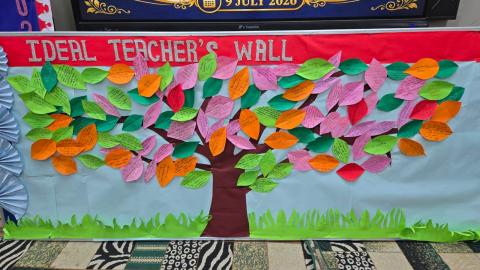
I recently came across a wall created by aspiring teachers. It was called the “Ideal Teacher’s Wall.” The instructions were simple: write about the teacher you think is ideal, write about a teacher you remember and why you remember them, and perhaps most importantly, write about the qualities you would like to develop in yourself as a teacher. There were almost a hundred leaves on that wall. I began reading them one by one, and after a while, I stopped looking at individual responses and started looking for a pattern. There were the familiar words—kind, patient, supportive, friendly, understanding, humble, motivating, inspiring. But when these words appeared again and again, they began to tell a larger story. The aspiring teachers did not seem to imagine an ideal teacher primarily as someone who knows everything. They imagined an ideal teacher as someone who understands someone. One student wrote that a teacher should try to understand the mindset of students and help them academically rather than pressurising them. Another said that a teacher should be friendly so that students can approach them without fear. Someone else described an ideal teacher as a supportive facilitator who resolves issues with kindness.
That distinction matters. Children do not experience a teacher only through what the teacher teaches. They experience the teacher through how the teacher makes them feel while they are learning. A teacher may know mathematics brilliantly, but if a child is frightened of asking a question, what happens to that knowledge? A teacher may have impeccable command over a subject, but if a child is constantly worried about being laughed at for making a mistake, will that child speak? The aspiring teachers seemed to recognise this intuitively. They spoke about teachers who were approachable, non-judgemental, empathetic and fair. They wanted teachers who would listen actively, treat everyone equally and create a space where students could reach out without fear. Perhaps this is why “supportive” appears so frequently on the wall. It is not merely a teaching quality; it is a relational quality. The child is not just asking, “Can you teach me?” Somewhere underneath it is another question: “Will you stand with me while I learn?”
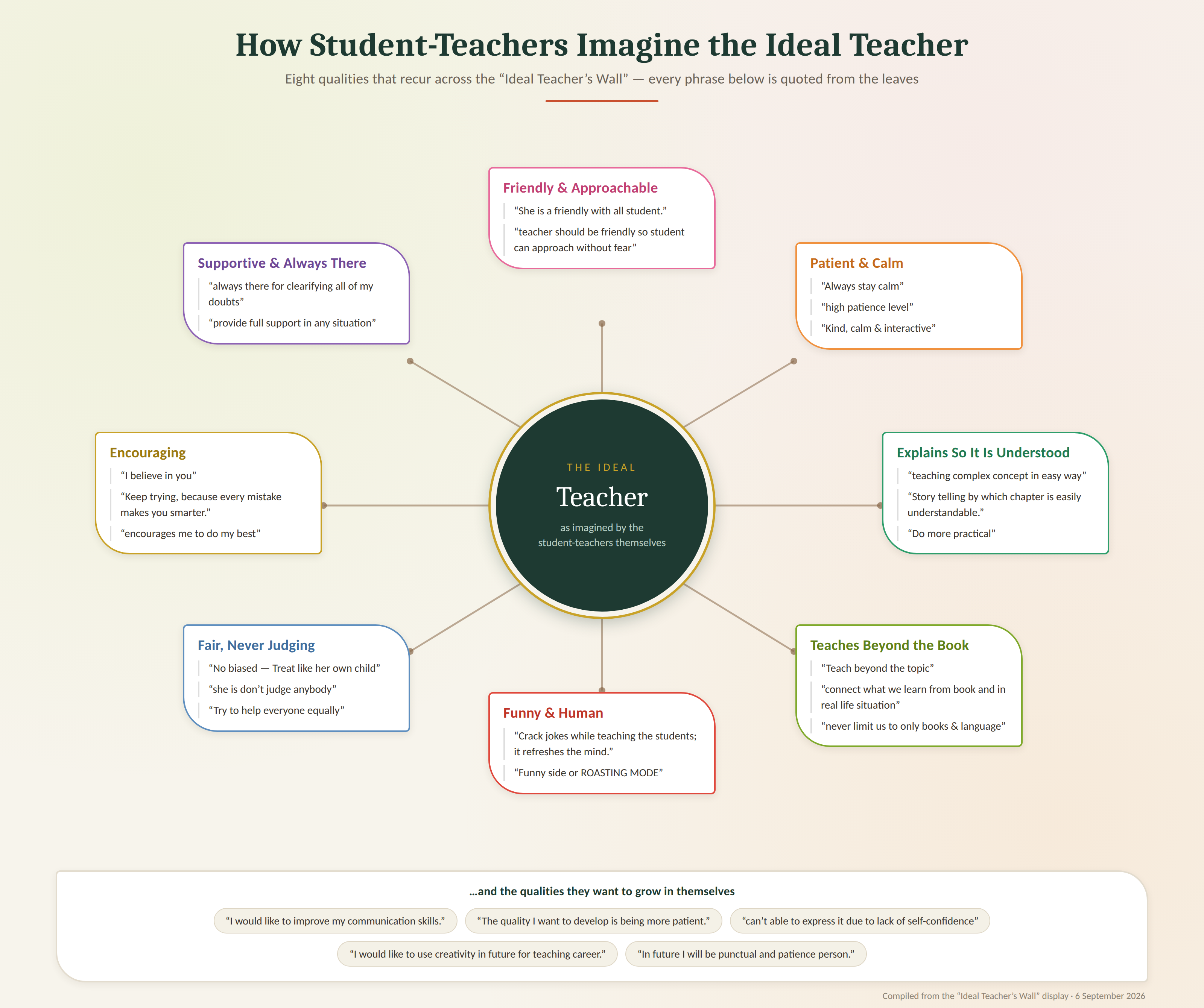
There is another striking feature of the wall. The ideal teacher, in their imagination, is not someone who is perpetually serious. There are references to a “funny side,” “roasting mode,” cracking jokes while teaching, having a “chill mood” and making learning enjoyable. There is a recognition that a teacher can be disciplined without being intimidating. One aspiring teacher even wrote that strictness may be necessary, but it can be exercised politely rather than through rudeness. This is an interesting understanding of authority. It is not a rejection of authority; it is a reimagining of it. Perhaps we have for too long confused a serious teacher with a serious personality. The students these future teachers want to teach may not need a teacher who constantly reminds them who is in charge. They may need someone who can be respected without needing to be feared. And then there is the question of what these aspiring teachers themselves remember. Their favourite teachers are not remembered merely for the lessons they taught. They are remembered for how they treated people. One was remembered for patience, another for equality, another for being cheerful and polite, another for treating students like her own child, another for helping with doubts and queries, and another for boosting confidence. One teacher gave a student “the right direction” in life. Another had taught English in such a way that, even after many years, the student could remember every word. There are also repeated references to teachers who connected books with real-life situations, explained complex concepts simply, taught beyond the textbook and made learning enjoyable. We often measure teachers through what they deliver: lessons completed, concepts covered, assessments conducted, syllabus finished. Students, however, seem to remember them through what they leave behind. A teacher may complete the entire curriculum and still be forgotten. Another may teach one idea, one sentence, one gesture of encouragement—and remain present in a student's life for years. Perhaps this is the invisible curriculum of teaching: what children learn about themselves from the way a teacher looks at them.
What makes the wall even more meaningful is that the aspiring teachers were not simply describing the teacher they wanted. They were also noticing the teacher they themselves still needed to become. One wants to become more patient. Another wants to improve communication skills. Someone wants to develop self-confidence. Someone recognises creativity as a strength but communication as an area for growth. Others speak of empathy, fairness, listening, teamwork and the ability to take everyone along. There is something deeply reassuring in this honesty. An ideal teacher is not being imagined as a finished product. Becoming a teacher is also being understood as a process of becoming a person. You cannot teach patience without practising patience. You cannot create confidence while constantly doubting yourself. You cannot ask children to become lifelong learners if you have stopped learning yourself. So perhaps the real question is not, What makes an ideal teacher? The more difficult question is, What kind of person must I become if I want to be that teacher?
The wall tells us what a generation of aspiring teachers has experienced, what they have valued, what they have perhaps missed, and what they hope to offer their own students. And their answer is surprisingly human. They want to be teachers who listen, explain, encourage, laugh, remain calm, treat students equally, make difficult things easier, connect books with life and do not judge too quickly. They want to be approachable enough for a child to walk up and say, “I don't understand.” And perhaps, at the end of the day, they want to be the kind of teacher who makes a child feel that they matter.
- Log in to post comments