
The Birth of a Teacher
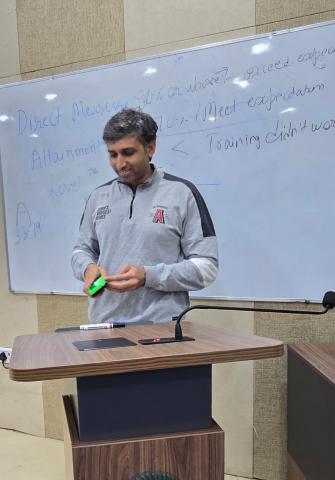
Last week, I spent two and a half days with a group of student teachers, guiding them through micro-teaching. We worked on different teaching skills—introduction, questioning, stimulus variation, blackboard writing and explanation. Each student prepared a lesson plan and presented a small module focusing on one of these skills. And they repeated it for each skill. I was supervising fifteen students, and at the end of the three days, I gave them a small pep talk. I thought I would share some of those thoughts here.
It was nice hearing from all of you. The feedback you get can sometimes be very disheartening for someone. I assume that receiving feedback is an important parameter for rating this session as a success. Whatever feedback you received was meant for your improvement. All of you identified on your own which skills you liked and where you felt the need for further improvement. I think that was the exact purpose of this micro-teaching. When I was thinking about it, I remembered an analogy. It is like cooking a vegetable dish at home. Chopping potatoes, cutting onions, and slicing green chillies are all separate tasks. Ultimately, the goal is to prepare the final dish, which represents the full lesson plan. Micro-teaching is like chopping the potatoes, cutting the onions, and preparing the chillies separately. Ultimately, you combine everything to cook the meal—the full lesson plan. When you go into an actual classroom, you won't be delivering micro-lessons; you will be delivering full lessons, right?
Having said that, before you leave, I want to share a couple of thoughts.
As I referred to earlier, remember when I mentioned the flying aircraft analogy, where the experience of a pilot is measured in flying hours? When someone asks us, “How old are you?” and we say 18 or 20 years old, the actual counting for a teacher should start from the day you step into the classroom as a teacher. Your journey as a teacher starts from that moment. Imagine that for the first three, four, or five years, you are like a toddler in the classroom. Right now, as you go in as trainees, it is like the birth of a teacher. Go with that mindset so that you remain open to learning. Whatever feedback comes your way, don't take it as a personal judgment on you, because at this stage, you have so much left to learn. I often say that an actual classroom is like a black box. Nobody knows in entirety how to teach because there are children coming from so many different contexts. In teacher training colleges, skills are taught, which is very important. However, there will be places where those skills alone won't work. You will meet many children in your class where the skills you learned don't seem to apply.
Then, what works? What comes into play?
That is where your ontology comes in—a philosophical term that essentially refers to your personality, who you are as a person. Much research points to the fact that, in a classroom, who you are as a person holds greater value than just your skills. When you reflect back and think about the teachers from whom you learned the most in your school or college, you might realise you learned fewer technical skills from them, but you remember them because they were wonderful human beings.
What does this mean?
Skill is important, but becoming a good person is even more important. You have to continuously work on becoming a person. Since this is a vast topic, you must constantly shape your personality from both the outside and the inside. To give an internal example: sometimes a thought might pop into your mind, “Why did this happen only to me?” This happens often. But as someone who is growing internally, your mindset changes. Instead of thinking, “This happened only to me, I have bad luck,” you begin to view things in a broader perspective. You realise, “This happens to everyone; right now, it's my turn to face it. I will deal with it and learn from it.” Internal thoughts and voices like these constantly arise in your mind, and shaping them is part of your journey. Of course, the external aspect is also crucial because that is what is mostly observed, noticed, and watched. You should continuously work on how you carry yourself, your presence, and how to keep improving.
Lastly, I want to say this because I don't know if I will get another opportunity to interact with you in such a small group.
The children you will deal with during your training, and likely later on, come from very poor and underprivileged households. Most of these children need a lot of care and love because the homes and neighbourhoods they come from are filled with structural violence. Violence, verbal abuse, and physical fights are part of their daily lived experiences. That is what they see and hear every day. As a teacher, you must ensure that you present an alternate vision of life to them—that life can exist beyond this, where there is no violence or abuse. You should stand before them as role models so that faith in a better life is cultivated within them. Right now, hearing this sounds fine, but in an actual classroom, there will be many occasions when you feel like engaging in corporal punishment. However, you must exercise unique restraint. A child learns nothing from being hit. They are very small; physical punishment will only create hatred in their minds—not just toward you, but toward studies and learning itself. So, stay completely away from physical punishment.
Continue to work and grow as a teacher. This is just the start, the beginning of this journey.
As for myself, I always consider myself to be on a journey. I am constantly learning; there are many things I don't know, and I continue to work on how I can learn them. Perhaps that is what being a teacher really means—not that one has learnt everything, but that one remains willing to learn.
So, that was an overall short lecture.
I really enjoyed being with all of you for these two and a half days.
Thank you very much!
All the best!
- Log in to post comments