
Language Was Always Artificial
Certain things become so deeply ingrained that they begin to appear natural, even biological. It was fascinating for me to realise that language itself is an artificial construct. Human beings spent millions of years on this planet without language. Over the course of evolution, they acquired it, and the necessary biological adaptations followed over time. It is somewhat similar to how lungs evolved as aquatic species gradually became amphibians and eventually terrestrial creatures. The need to communicate, cooperate, and coordinate at a larger scale ultimately gave birth to language. Language is not an innate object found in nature. It is a human-made symbolic system that evolved socially over millennia.
Today, language is so deeply embedded in human existence that it appears inseparable from our nature. Perhaps that is what Derrida meant when he wrote, "There is nothing outside the text." Whether or not one agrees with his philosophical position, it is difficult to deny that our understanding of reality is mediated through language. We do not merely use language; we inhabit it.
In this context, the emergence of the large language model and its extraordinary capacity to produce language may not be as artificial as it is often portrayed. The intelligence behind it may be artificial, but the language it produces is not. Language has always been an artificial human invention. What AI is doing is extending humanity's ability to generate, organise, refine, and circulate language at an unprecedented scale. In that sense, it is not replacing language; it is amplifying one of humanity's greatest inventions.
Language, in its spoken form, helped build cultures, traditions, philosophies, and rituals. In its written form, it enabled international trade, preserved civilisations, and made empire-building possible. Every major leap in human civilisation has, in one way or another, been accompanied by an expansion in our ability to create and transmit language.
Now comes a new stage: language produced by machines. What might it do?
Perhaps it will contribute to the emergence of even more sophisticated forms of culture and collaboration. Again, if I borrow from Derridian logic—if nothing exists beyond texts—and if the texts themselves become richer, more nuanced, and more accessible, then perhaps life itself may become more aesthetic, more thoughtful, and more refined. Whether this possibility materialises or not remains to be seen, but it is certainly worth contemplating.
Recently, I witnessed a powerful demonstration of what artificially produced language can accomplish.
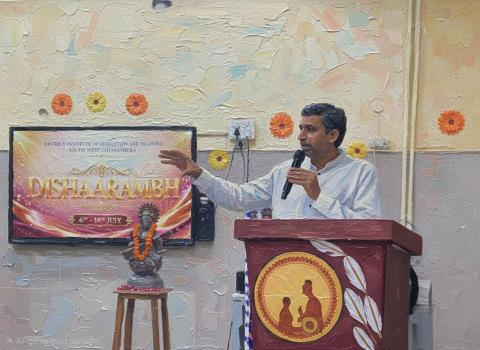
During the orientation programme for a new batch of students, on the fourth day they were divided into groups of six to eight and asked to prepare a skit on inclusive classrooms. They were given barely thirty minutes to conceptualise, script, rehearse, and perform.
When the presentations began, I was genuinely mesmerised.
In most groups, the scripts and dialogues had been generated using AI, while the students brought them alive through their performances. Together, they managed to capture almost every essential dimension of inclusive education. The dialogues were simple, memorable, and emotionally compelling.
"We are different, but not disabled."
"I am slow, but I can learn."
"We don't need sympathy; we need equal opportunity."
"Nothing about us without us."
These were not merely catchy lines. They reflected years of scholarship, activism, and advocacy distilled into accessible language.
What often takes a six-month certificate programme to communicate, these students conveyed remarkably well in a ninety-minute exercise, including preparation and presentation. However, the internalisation of these concepts remains unexamined. The experience left me wondering whether we are underestimating what high-quality language can enable when it becomes universally accessible.
Without access to AI, such a performance would have been almost impossible within such a limited timeframe. The same was evident in the beautifully designed slides displayed on the smart board, also generated with the assistance of AI. The technology did not replace the students' creativity; rather, it expanded the possibilities available to them.
I do not underestimate the value of the human cognitive process involved in producing words. There is immense beauty in struggle, revision, and slow thinking. But demonstrations like these require us to recognise another possibility—that the value of language may also lie in what it enables people to do. In many ways, this resonates with the pragmatic school of thought, which ultimately judges ideas by their consequences in the real world rather than by their origins.
I am fascinated by the possibilities that the artificial production of language opens up.
The smoothness of AI-generated language and its near absence of grammatical errors make many people uncomfortable. They long for rough edges, imperfections, and raw expression. I understand that sentiment. Yet, somewhere I also see a certain puritanical pride disguised as concern for authenticity.
For millions across the world, this so-called "rawness" was never a matter of artistic choice. It was a structural disadvantage. It limited academic opportunities, professional mobility, and participation in global conversations. Those who inherited rich linguistic and cultural capital enjoyed an enormous advantage over those who possessed brilliant ideas but lacked polished expression.
AI has begun to disturb that hierarchy.
Today, someone with an ordinary command of English but an extraordinary idea can communicate with a confidence that was once reserved for a privileged few. The gatekeeping function of language is slowly weakening.
Perhaps this is where I see the greatest promise of AI—not merely as a technological breakthrough, but as a linguistic equaliser. If language has always been humanity's most powerful technology, then democratising access to good language may become one of the most consequential transformations of our time.
History reminds us that every major leap in civilisation has been preceded by a revolution in language—from speech, to writing, to print, to the internet. Large language models may well represent the next chapter in that story. The important question, therefore, is not whether machines can write. The more important question is: what kind of society will humans build when the power of language is no longer the privilege of a few, but the shared capacity of many?
- Log in to post comments