
Between Policy and Practice: A Persistent Paradox
There is a familiar paradox in the education sector—particularly in school education—that one hears quite often. Teachers say policymakers can’t understand even basic things. On the other hand, policymakers wonder, how can teachers not fulfill even these basic, simple directions?
Literature has long been critical of top-down approach in education. However, this tension is not new; it has stretched across generations. Yet, little seems to change on the ground. The friction between bureaucracy and the lived realities of teachers and students continues.
I think the problem is more complex than it appears. Within a school, teachers feel quite confident about implementing an innovative practice because they understand the context. They can see the breadth and depth of their situation and often feel that things can be shaped or shifted. But that context is limited. The moment one steps beyond a single school and begins to think of thousands of schools, everything changes. No two schools are the same—contexts differ, as do teachers, principals, and children.
There are multiple layers of context at play. What feels “easy” to implement within one classroom becomes difficult at scale. Yet teachers rarely get the opportunity to see this broader picture. On the other side, top bureaucratic officers—sitting as heads of departments—operate from a very different “top-angle” view.
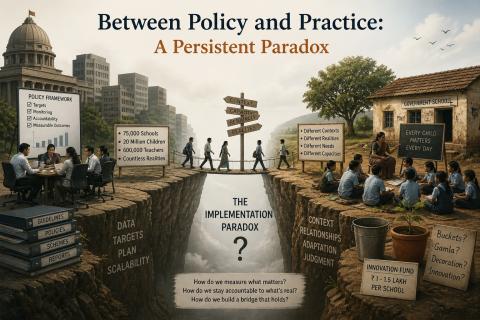
I remember once looking at data from a state like Bihar. I was struck by the sheer scale: nearly 75,000 schools, about 20 million children, and around 600,000 teachers. These schools are spread across every kind of geography—plains, riverbeds, flood-prone regions, and more. It is a massive system. At that moment, I realised that while teachers certainly need support, the questions at the policy level are different: What measures will work across the scale? How will progress be tracked? How can resources be distributed? The complexity multiplies instantly.
In a single school, if a principal decides to create an enabling environment for teachers, it is relatively manageable. Much is already known—the teachers, the children, the available resources. But for a state-level officer looking at tens of thousands of schools, the challenge is of an entirely different order.
Perhaps this is why most policy pushes from the state lean toward what is quantifiable—what can be measured, monitored, and made accountable. The moment we shift towards the lived experiences of teachers and learners, it becomes difficult to translate those into numbers, to track progress, or to assign accountability.
I call this the implementation paradox. It is likely to persist unless we find ways—through research and perhaps technological interventions—to make these human experiences more visible, even measurable. But that leads to another question: if human experiences are quantified, how authentic will they remain?
This reminds me of a conversation I had with a friend who was working at the policy level a few years ago. They had this belief that in every school there are at least a few teachers inclined towards action research—teachers who just need a bit of support and space to experiment, present their work, and write about their practices.
So, with that intent, the department rolled out an “Innovation Fund,” allocating nearly 100 million rupees. Each school received around 1 to 1.5 lakh rupees.
He then said—that’s where things became difficult. Many schools simply didn’t know how to visualise “innovation” in practical terms. And eventually, in several places, the money ended up being spent on buckets, flower pots (gamla), and other decorative items—all in the name of innovation.
This makes it clear: the issue does not lie entirely with schools or with the bureaucracy. It is somewhere in between.
This is where research must step in—with sharper clarity. It must help policymakers understand what exactly should be measured, how it can be implemented, and how qualitative change can be meaningfully monitored. At the same time, it must help teachers understand why policy often prioritises what it does—and what its limitations are.
What we need is a middle ground. A space where schools and teachers have the flexibility to exercise their judgment—going beyond what policy strictly measures—while still working within a broader framework.
It is a paradoxical situation. And unless research and technological innovation respond to it thoughtfully, the distance between policy and practice will remain—not because either side is unwilling, but because both are looking at the same system from very different vantage points.
- Log in to post comments