
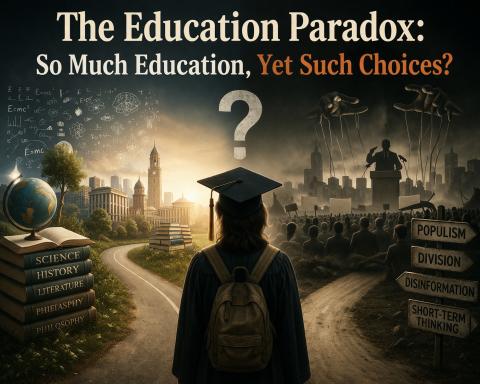
The Education Paradox: So Much Education, Yet Such Choices?
In his book Sapiens, Yuval Noah Harari compares the quality of life between hunter-gatherers and modern people. He brings up an example that, despite the obvious hardships and lack of modern comforts back then, in terms of actual quality of life, those people may have had it better. They ate a massive variety of nuts, foods, and meats; their bodies received a full spectrum of nutrients, including all the necessary proteins and vitamins.
He contrasts this with modern life for poor people in places like Bangladesh, Vietnam, and China, where millions upon millions of people eat the same set of rice and pulses day after day, year after year. In terms of nutrients and variety, their diet is quite limited. Their work is often mind-numbingly repetitive, stretching for twelve hours or more, whereas the life of a hunter-gatherer was engaging and energizing. They would hunt for a while in the morning, and by midday, they had eaten and could rest. By the evening, they came together as a community—to drink, to dance, to be. It was a fascinating thing for me to read.
Lately, while observing the current politically induced wars raging across the globe, I have been thinking about our situation in the 21st century. By all parameters of science, technology, and education, we likely have the most educated population to ever occupy this planet. Yet, what is truly surprising to me is how this mass of highly educated people has chosen, perhaps, the least capable leaders humanity has ever seen.
It is a troubling realization, and it seems to be irrespective of geography. Whether it is the most powerful country in the world or the least powerful; whether it’s a nation with a hundred Ivy League universities or a country with no top-ranking institutions at all—the way people select the political leaders who make our most vital decisions is baffling. We have handed power to those who often seem deeply unprepared for it.
This is where the discomfort deepens. I wonder: what exactly is our education producing? Are we nurturing thoughtful, discerning citizens—or merely efficient, obedient workers? Because if the most educated societies are repeatedly choosing poor leadership, then education, as we define it, may be failing its most important civic test. There seems to be a widening gap between education and wisdom.
It is truly surprising to see how, across the globe, millions are suffering. Thousands are stranded at sea, millions are losing their jobs, and millions more are standing in long queues just to get fuel supplies.
It makes me look back at hunter-gatherer communities again. Back then, the strongest warrior was chosen as the leader—someone who could demonstrate the ability to lead, bring security, and protect the people. There was immediacy. There was accountability. If a leader failed, the consequences were direct and visible. On the contrary, what we see today is a strange distance—the most incapable making decisions on our behalf, while the capable, educated citizens are left managing the consequences in their everyday lives. Perhaps this is also a kind of security paradox. Leadership today is so far removed from everyday life that the consequences of poor decisions are absorbed by the masses, not the decision-makers. The distance protects power, not people.
This isn't just about one or two countries; it’s a global irony. The issue isn't only that universities aren't producing graduates who can be meaningfully employed in the industry; the much larger question is why we are consistently choosing poor leadership across the globe. One country after another, if we take a closer look, the pattern feels strangely similar. What is happening? And more importantly—what is all this education actually doing for us?
- Log in to post comments