
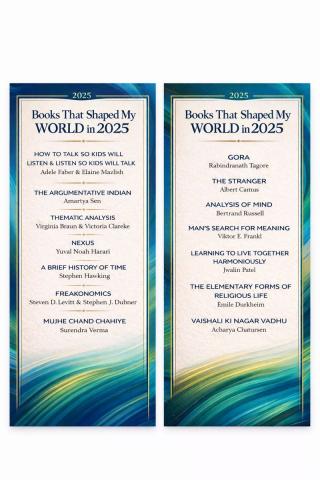
Looking Back at My Reading in 2025
This is the last Sunday of the year, and I wanted to pause and take stock of what I read in 2025—why I chose these books and what stayed with me. My reading is often shaped by recommendations from people I value and by suggestions I come across while searching for specific ideas or questions. I’m sharing this in that same spirit. Like many others, I began the year with an ambitious list of nearly 50 books maintained in a Google Sheet. Each finished book was marked in green. I aimed for diversity in genre, but by the end of the year, I managed to complete roughly 25% of that list. Still, these books tell a clear story about how the year unfolded intellectually.
Parenting and Communication
I began with How to Talk So Kids Will Listen & Listen So Kids Will Talk. Engaging meaningfully with my daughter is a daily challenge, and I felt the need to consciously develop a language for communication rather than persuasion. The book was practically useful—especially ideas like writing notes and thoughtful praise. Not all suggestions were transferable to my context, but as a light and reflective read, it helped me rethink everyday interactions.
Academic and Research-Oriented Reading
The Argumentative Indian by Amartya Sen stood out sharply. Reading it, I was struck by the sense that such a book is the outcome of decades of sustained academic engagement. I was particularly drawn to his reflections on the “idea of knowledge”—whether knowledge can have boundaries, or belong to a nation. These questions feel especially relevant in the present discourse around the Indian knowledge system. Thematic Analysis was a contextual necessity. Given my engagement with qualitative research and interview data, understanding coding and theme-building as a rigorous process was important. This book added clarity and depth to my methodological practice.
I also read The Elementary Forms of Religious Life by Émile Durkheim toward the end of the year. Even in parts, his analytical treatment of religion as a social phenomenon is impressive and demanding.
Power, Information, and Control
Nexus by Yuval Noah Harari was both engaging and unsettling. Having read Sapiens, Homo Deus, and 21 Lessons for the 21st century, I found Nexus especially disturbing in its discussion of witch hunts as a global phenomenon, particularly in medieval Europe. The book raises uncomfortable questions about how power circulates and who controls information. His imagination of an AI-shaped future is equally compelling and alarming.
Science and the Limits of Imagination
A Brief History of Time by Stephen Hawking was an absorbing read. I even attempted—perhaps too ambitiously—to read parts of it to my daughter. I managed around 70–80 pages before realizing it wasn’t holding her interest. For me, however, the book was transformative. If one is looking to stretch imagination beyond everyday boundaries, this book does exactly that.
Hits and Misses
Freakonomics didn’t work for me. Despite its popularity, I found it to be a collection of loosely connected data-driven curiosities. It may appeal to many, but it didn’t leave a lasting impression on me.
Literature and the Human Condition
Mujhe Chand Chahiye had been on my list for a long time. The characters feel alive, and the narrative craft—especially the journey from a village to stardom—is striking. Gora by Rabindranath Tagore remains one of the deepest explorations of nationalism I have read. Through the character of Gora, Tagore presents the idea of the nation in a way that feels especially relevant in an age of hyper-nationalism. The Stranger offered a stark engagement with absurdity. I appreciated its restraint and the philosophical unease it leaves behind. The Analysis of Mind was demanding. While not an easy read, Russell’s analytical approach to memory and motivation was intellectually rewarding.
Man’s Search for Meaning stayed with me largely because of its context. Frankl’s experience as a Holocaust survivor adds a gravity that is difficult to ignore, reminding us of the extreme limits of human suffering and resilience. Learning to Live Together Harmoniously is an important contribution to educational thought. Through careful field research in alternative schools in India, it brings the idea of holistic education into concrete focus. Vaishali Ki Nagarvadhu was immersive. Even after finishing it, I felt reluctant to step out of the world the author created.
Looking Ahead
I plan to make another reading list for 2026. I see nothing wrong with making lists—or with buying more books than one can realistically read. The list itself is a form of hope. As the year ends, I’m already looking forward to the next set of books and the questions they might bring along.
- Log in to post comments